DEICING FLUID
Space-Saving Pumping of Deicing Fluid at Airports
How to safely and reliably pump highly viscous deicing fluids
Safely operating a major international airport in winter requires reliable storage and transport of deicing fluids. When existing systems are outdated, available installation space is limited, and high demands are placed on safety, ease of maintenance, and media quality, modernisation becomes a technical challenge. This was precisely the situation at John F. Kennedy International Airport, where a new deicing storage and fluid transfer system was implemented.
As a global specialist in handling complex media, NETZSCH Pumps & Systems also offers tailor-made pump solutions for safety-critical infrastructures. We will show you how to pump highly viscous, shear-sensitive deicing fluids in a space-saving, maintenance-friendly, and reliable manner.

Individual Consulting
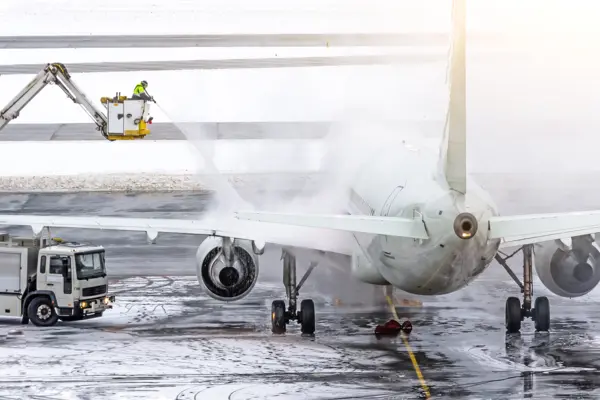
Deicing fluids on airports: Challenges for pumps
Type IV deicing fluids are based on propylene glycol and are characterised by a very high viscosity of around 30,000 cP. This high viscosity is necessary to form a protective, adhesive layer during aircraft take-off, but makes pumping technically challenging. At the same time, these media are sensitive to shear forces. Excessive turbulence can reduce the fluid’s viscosity, thereby reducing its effectiveness. In addition, deicing systems place high demands on operational safety, environmental compatibility and safe access for maintenance work, as they are often installed in underground tanks.
Limited tank capacity and difficult maintenance
The existing deicing storage and transfer system in Terminal 1 of the airport was initially installed in 1996 and had exceeded its technical service life. The underground tank, with a capacity of almost 570 hectolitres, was divided into several chambers to accommodate horizontal pumps. As a result, only a part of the total capacity was actually available for Type IV deicing fluids. In addition, the horizontally installed pumps were accessible only through a narrow maintenance hole opening. Maintenance work required entry into a confined space, which was not only time-consuming but also posed significant health and safety risks. The aim of the modernisation was therefore to make the full tank capacity usable, improve maintenance accessibility and implement the new system within the existing footprint.
Submersible pumps as a space-saving and safe solution
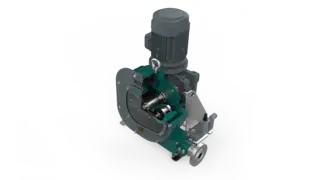
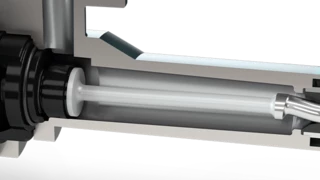
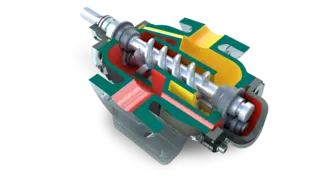
In collaboration with the engineering company responsible for planning, a vertically mounted, submersible NEMO® progressing cavity pump was selected. This pump solution is specifically designed for highly viscous, shear-sensitive media and can be installed directly in the underground storage tank. The solution is impressive for several reasons. Progressing cavity pump technology conveys the deicing fluid with minimal turbulence, thereby preserving the medium’s rheological properties. Furthermore, the vertical, submersible design saves space in the tank and utilises the entire available storage capacity. At the same time, it reduces construction effort, as the base plate and tank cladding can be reused. The pump’s external accessibility also significantly improves maintenance and work safety, as there is no need to enter the tank. Compared to vertical centrifugal pumps, which are suitable for water-like Type I deicing fluids, the NEMO® BT submersible pump offers significantly smoother conveyance of viscous Type IV fluids. “We knew we needed a pump system causing little turbulence to ensure the shear-sensitive properties of the fluid were not destroyed. The NEMO® pump was clearly superior to other options and was the only solution that could be installed in the required vertical position”, said consulting engineer Dennis Eryou, PhD, PE.
The new system allows the full tank capacity of 570 hectolitres to be utilised while reducing construction costs. The safe and gentle conveyance of deicing fluid contributes to consistent product quality and, in turn, to flight safety during winter operations. In addition, the airport benefits from improved maintenance accessibility, lower operational risks and overall higher operational reliability. Based on the positive experience, the new design is also being considered for other terminals.
Contact the experts at NETZSCH Pumps & Systems and discover how we can design your storage and transfer processes for demanding media safely and efficiently. We are happy to support you with modernisation and new construction projects.
NEMO® BT immersible pump
- Medium: Deicing fluid type IV (propylene glycol-based)
- Capacity: 13,6 m³/h
- Pressure: 3,4 bar
- Temperature: 0 to 18 °C
- Other: Highly viscous, shear sensitive