RAW SEWAGE
Renovation Without Downtime, Even With a Moving Worksite
How to ensure uninterrupted operation of a sewage treatment plant during renovation
How can a sewage treatment plant be refurbished without interrupting ongoing operations? This was the challenge faced by the Bad Reichenhall sewage treatment plant when, as part of a concrete refurbishment project, both the primary settling tank and the inlet and outlet pipework needed to be repaired. As the construction site changed location repeatedly, a stationary solution was out of the question. What was required was a pumping system which could be deployed flexibly along different sections of the pipeline without compromising the treatment process.
We’ll show you how the Bad Reichenhall sewage treatment plant completed all repair work using a mobile rotary lobe pump without interrupting operations.

Individual Consulting
Challenges involved in pumping raw sewage
Raw sewage from the primary settling tank contains a high proportion of solids, including sand, wood debris, toilet paper residues and faecal matter, with particle sizes of up to 70 millimetres. A pump designed for this application must be capable of handling such contaminants without becoming blocked or suffering a loss of performance. Added to this is a suction depth of up to seven metres from the tank, with fluctuating water levels. Following interruptions or in the event of air entrapment in the suction area, the pump must restart automatically. As the construction site changed location repeatedly during the refurbishment, the pumping system also had to reliably cover a delivery distance of around 200 metres and be capable of being repositioned at different locations within a short time.
Concrete renovation without interrupting operations
With an annual wastewater flow of around 3,500,000 cubic metres, the Bad Reichenhall sewage treatment plant is a vital part of the town’s infrastructure. It is operated entirely by the local authority, with the focus on local control and sustainable management. As part of a concrete refurbishment project for the primary settling tank, extensive work was required, including refurbishing the inlet and outlet pipework. “You can’t simply shut down a sewage treatment plant to gain access to the affected areas,” explains Peter Wohlschlager, an electrician at the Bad Reichenhall sewage treatment plant. A solution was therefore needed to complete the repairs quickly and easily without interrupting operations. NEMO® progressing cavity pumps have been used in Bad Reichenhall for several years. However, these are permanently installed and not designed for flexible, repeatedly relocatable bypasses at changing positions. Back in 2021, the Bad Reichenhall sewage treatment plant had already decided to purchase a TORNADO® Mobile as a flood protection pump to bridge any potential failure of the three flood pumping stations. For the concrete repair work, it therefore made sense to use the same mobile pump for the temporary diversion of the raw sewage as well.
Robust pump on wheels for any site
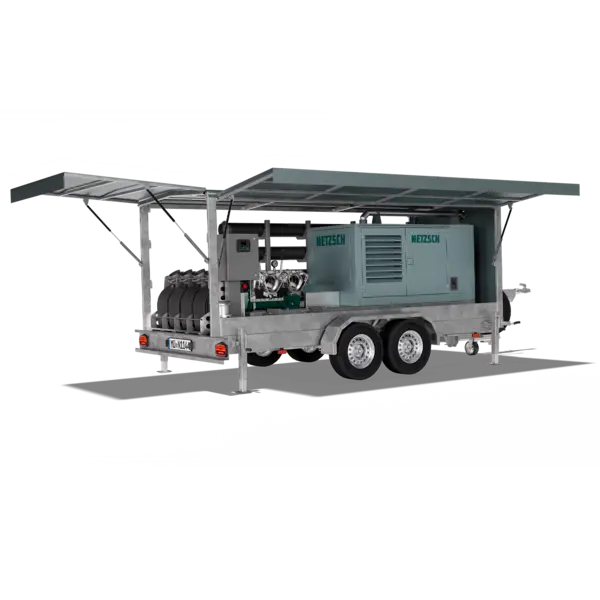
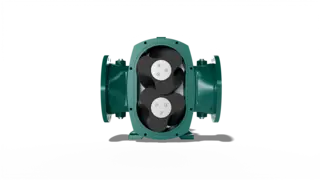
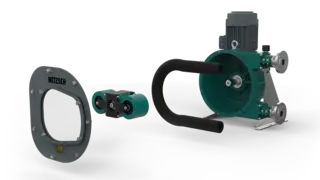
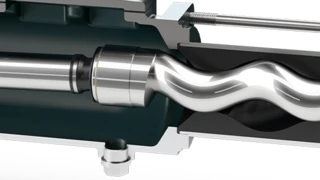
Following consultation with Pitt Mair, Area Sales Manager at NETZSCH, there was nothing to prevent the pump from being used: “The TORNADO® Mobile was developed specifically for applications such as this.” The TORNADO® XLB-8/2 rotary lobe pump is mounted on a trailer, meaning it can be quickly and easily deployed exactly where it is needed. This eliminates the need for a time-consuming reinstallation whenever the construction site moves to a new location. Inside the pump, two three-lobed helical lobes rotate, meshing closely with one another. Their rotary motion creates a vacuum on the suction side, which automatically draws in the fluid to be pumped. This enables reliable suction from depths of up to seven metres, as well as an immediate restart following interruptions or if air enters the suction area. The robust design of the rotary lobe pump can handle solids with a particle size of up to 70 millimetres, including sand, wood debris, toilet paper residues and faecal matter. Consequently, the flow rate remains stable even with heavily contaminated raw sewage. The patented FSIP® design also allows you to carry out maintenance directly on site, without having to remove or dismantle the pump. For many tasks, simply opening the casing cover is sufficient to access the pistons, seals and other key components. This reduces the amount of servicing required and minimises your downtime. “The design is geared towards making transport, flexible operation and maintenance tasks as simple and intuitive as possible”, explains Mair. “Even replacing wear parts or carrying out a quick clean can be done in just a few steps.”
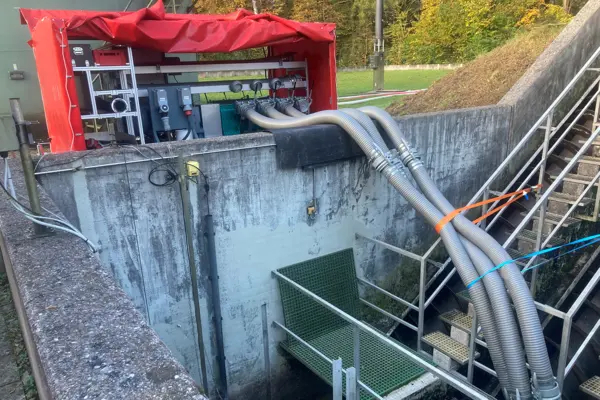
The TORNADO® Mobile was positioned close to the tank to ensure a short suction run. Using three suction hoses, the raw effluent was fed directly into the pump, which reliably transported it over a distance of around 200 metres to another part of the plant at a constant flow rate of up to 1,000 cubic metres and a maximum pressure of three bar. In this way, the entire contents of the 1,500-cubic-metre primary clarifier were completely diverted. Meanwhile, the plant’s treatment process continued without interruption, whilst the damage to the drained tank and the dried-out pipes was repaired and sealed using an inliner. “With the TORNADO® Mobile, we were able to quickly implement a solution for the renovation of primary settling tanks and pipework. The expert advice provided by our colleagues at NETZSCH made the project a complete success,” said Wohlschlager.
Get in touch with the experts at NETZSCH and let us advise you. We’d be happy to help you planning your next maintenance or renovation project.
TORNADO® Mobile