SODIUM HYPOCHLORITE
Safe Dosing of Sodium Hypochlorite Without Downtime
How to stabilise disinfection dosing at elevated temperatures
Are you familiar with unplanned supply interruptions, manual venting, and rising operating costs when dosing sodium hypochlorite in water treatment plants? Especially at elevated ambient temperatures, medium degassing can significantly impair process stability. Continuous, safe disinfection often requires additional personnel and maintenance costs.
We show you how things can be done differently! As a global specialist in handling complex media, NETZSCH Pumps & Systems has developed a solution specifically tailored to the physical properties of demanding chemicals. Read on to explore how to reduce your operating and maintenance costs.

Individual Consulting
Challenges when pumping sodium hypochlorite
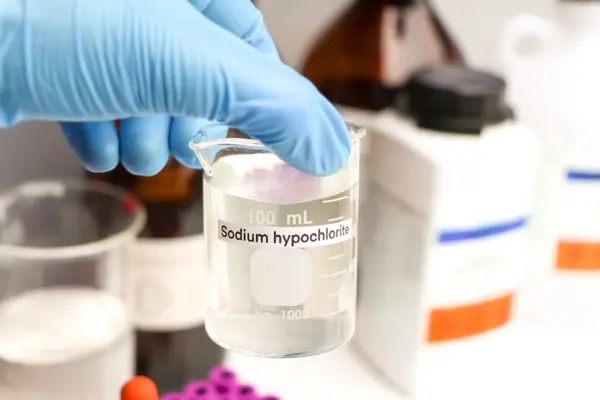
Sodium hypochlorite (NaOCl) is often used for disinfection in water treatment plants. However, the chemical solution is sensitive to heat and light. Even moderate increases in temperature can lead to decomposition and degassing, during which gases such as oxygen are released. This gas formation leads to vapour and gas bubbles in the supply and dosing system. In closed conductors, these bubbles tend to collect at high points, which can cause interruptions in delivery, especially with continuously operating dosing pumps. The challenge is to ensure consistent dosing accuracy even with unstable media.
Operational interruptions and high maintenance costs
Electrically operated double diaphragm pumps (EODD pumps) are used in many water treatment plants to dose sodium hypochlorite. These pumps enable precise dosing of the required amount of chemicals. In practice, however, EODD pumps are susceptible to gas bubbles in the supply system. As soon as vapour bubbles accumulate, the pump blocks and delivery comes to a standstill. Manual venting is required to resume operation. Especially in summer, this intervention may be necessary several times a month. Staff must be on site or come to the plant outside regular working hours. This results in considerable labour costs and additional expenses for spare parts and maintenance. At a plant in the USA, annual operating and maintenance costs exceeded 3,600 US dollars per pump.
How to dose reliably and with low maintenance
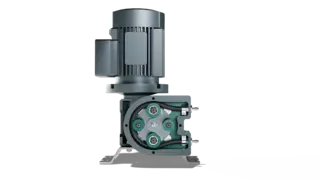
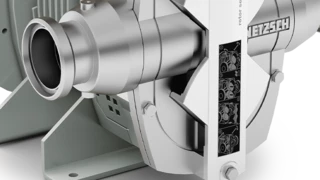
As an alternative to electrically powered double diaphragm pumps, a PERIPRO® hose pump chemical version from NETZSCH was used. The PERIPRO® is a peristaltic pump in which the compression of a multi-layer elastomer hose transports the pumped medium. Large, heavy-duty rollers ensure displacement of the medium and reproducible delivery characteristics. Due to the peristaltic delivery principle, the PERIPRO® can run dry indefinitely. Gaseous components in the medium, such as those produced by sodium hypochlorite degassing, do not impair delivery. Manual venting of the pump is therefore not necessary, thereby eliminating downtime and the need for plant personnel intervention. Another technical advantage is the minimised product contact. The pumped medium only comes into contact with the elastomer hose and the pump connections. In the version used, the PERIPRO® features a Tefzel-coated pump housing and a correspondingly coated pump cover, as well as PVDF- or polypropylene-pipe connections. This choice of materials ensures high chemical resistance and is particularly suitable for pumping aggressive and corrosive chemicals such as sodium hypochlorite. As the elastomer hose is the only wearing part in the pump, the required spare parts are significantly reduced. The hose can be replaced easily, quickly, and predictably, which reduces maintenance costs. At the same time, the PERIPRO® enables a dosing accuracy of plus / minus one percent, ensuring a constant flow rate and high process reliability in disinfection. In addition, the pump design includes a hose-leakage sensor and an integrated drainage system. These functions increase operational reliability and support controlled and safe plant operation.
Using the PERIPRO® peristaltic pump has completely eliminated previous delivery interruptions. Since the first pumps were installed in May 2023, the systems have been running continuously around the clock, even in climates with summer temperatures of up to 29 °C. Manual venting is no longer necessary, and annual operating and maintenance costs have been reduced by several thousand US dollars per pump. Even after a year of operation, the elastomer hoses remained in perfect condition.
Contact the experts at NETZSCH Pumps & Systems to make your dosing processes safer and more economical. We will be happy to assist you in designing your application and selecting the right pump technology.
PERIPRO® hose pump chemical version