BIOMASS
Pre-Shredding of Biomass for Increased Process Reliability
How to protect conveying systems in biogas plants with changing substrates
Today, biogas plants must process a wide range of energy crops and biowaste to operate economically. But how can highly variable substrates with a large proportion of fibre and solids be conveyed safely without risking unplanned downtime? And how can operators prevent pumps and pipes from being blocked by coarse materials?
As a global specialist in handling complex media, NETZSCH Pumps & Systems offers grinding systems optimally tailored to biomass, effectively protecting subsequent units and sustainably increasing process reliability in biogas and sewage treatment plants.

Individual Consulting
Challenges when pumping biomass
Substrates used in biogas plants vary naturally in composition and consistency. Silage maize, chicken manure with straw, cattle slurry, grass clippings or feed residues differ in fibre length, solid particle size and dry matter content. Long fibres from grass or straw, in particular, tend to clog, while coarse manure components can mechanically block pipes and pumps. In addition, high dry matter content of up to twelve percent makes stable conveyance difficult. The media are often poorly flowable, inhomogeneous and only predictable to a limited extent. Therefore, it is difficult to design pump technology to precisely target defined contaminant sizes without substantial safety margins.
Inadequate pre-treatment as a cause of wear
In many plants, the substrates are fed directly or inadequately pre-treated to the feed pumps. Conventional cutters or cutting devices often fail to achieve sufficient comminution with highly fibrous or coarse media. This results in unstable pumping conditions, increased wear on downstream pumps and pipes, unplanned maintenance work and, in the worst case, plant downtime. Oversizing the pumps is a possible safeguard, but it comes at the expense of energy efficiency. Moreover, it significantly increases investment and operating costs.
Pre-shredding for efficient biomass conveying
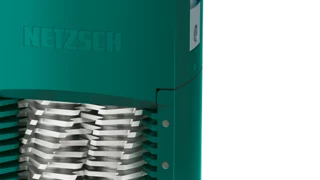
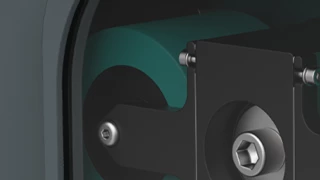
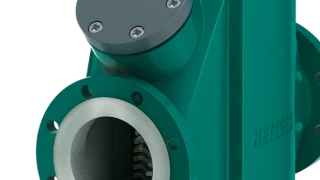
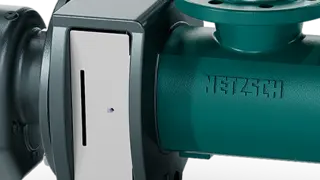
The solution to the challenges of pumping biomass is provided by NETZSCH. Depending on the solids and size, there are two different technologies to choose from: The M-Ovas® universal cutting plate macerator and the N.Mac® twin shaft grinder in inline or channel design. The M-Ovas® is designed for optimal flow, ensuring uniform media flow. This results in stable conveyance even at high dry matter content. Depending on the version, the grinder achieves throughput rates of up to 300 cubic metres per hour. Even media with up to twelve percent dry matter can still be reliably processed at conveyance rates of approximately 80 cubic metres per hour. An essential component of the M-Ovas® is the integrated cutting mechanism with hardened blades. The combination of a double-sided cutting plate and a blade head with carbide cutting blades ensures high cutting efficiency. This reliably shreds fibrous substrates, reduces clogging and prevents blockages in subsequent pipes and pumps. In addition, a heavy-material collection separator is integrated to remove objects, such as stones, from the medium already in the grinder. The separated materials can be removed through cleaning and discharge openings without interrupting operation, effectively protecting downstream pumps. The service-friendly design of the M-Ovas® also contributes to high system availability. The cutting blades and cutting plates are easily accessible through a large housing cover and can be maintained or replaced without dismantling the pipeline. The standard galvanised housing is also available in stainless steel for special requirements, thereby expanding the range of applications and increasing service life. Where perforated disc systems reach their limits due to particularly hard contaminants, N.Mac® twin shaft grinders are used. Two counter-rotating cutting shafts at low speeds of 40 to 50 revolutions per minute and high torque reliably shred even very solid, highly inhomogeneous components. In addition, the cartridge design of knives and seals greatly simplifies service and maintenance and minimises downtime.
Upstream shredding makes even highly variable substrates permanently pumpable. In a biogas plant with a dry matter content of around twelve percent, a stable throughput of eight to ten cubic metres per hour was achieved after adjusting the M-Ovas® to a perforated plate with a hole diameter of 18 to 20 millimetres. The connected NEMO® progressing cavity pumps have been conveying the substrate without issue ever since. In addition, maintenance costs have been significantly reduced.
Contact the experts at NETZSCH to optimally design your biomass processing for changing substrates. We are happy to assist you in selecting and integrating the right grinding solution.
M-Ovas® universal cutting plate macerator
- Medium: Biomass, slurry, manure, foreign sludge
- Capacity: Up to 300 m³/h
- Speed: 40 to 50 rpm
- Other: Up to 12 % Dry matter, fibre- and coarse material-containing media