WASTE PAPER
Gentle Pumping of Waste Paper Pulp in the Recycling Process
How to ensure stable and gentle feeding in recycled paper production
Global demand for paper is increasing steadily. The packaging sector alone is recording annual growth rates of approximately three percent. In Europe, more than 70 percent of paper products already come from recycled fibres. This development is increasing pressure on processing and conveying: Higher throughput, fluctuating quality, and increasing demands on resource efficiency. Process-stable waste paper conveying is therefore becoming a key factor in ensuring quality, cost-effectiveness, and long-term supply security.
As a global specialist in handling complex media, NETZSCH Pumps & Systems offers technically sophisticated pump solutions for the paper and pulp industry. We will show you how to reliably convey even sensitive recycling media.

Individual Consulting
Challenges when pumping waste paper
Recycled waste paper consists of a heterogeneous mixture of cellulose fibres, water and fillers. Depending on the recycling process, the solid content is typically in the double-digit percentage range, with elevated temperatures. A key challenge is to prevent undesired dewatering during conveyance. High shear forces, pressure peaks or pulsations can cause water to separate from the fibres already in the piping system. This not only impairs dosing accuracy but also directly affects the homogeneity and flatness of the subsequent paper webs. In addition, the process requires uniform, continuous conveyance to reliably feed the downstream dewatering and processing stages.
Increasing recycling rates raises requirements
The increasing use of recycled fibres poses particular challenges for the processing and conveying of waste paper. Fluctuating fibre qualities, increased solid content, and rising throughput requirements call for a conveying system transporting the moist pulp as evenly as possible and without additional mechanical stress. Even slight shear forces or pressure fluctuations can cause unwanted dewatering, thereby impairing the homogeneity of the raw material. Against the backdrop of growing production volumes, process-stable conveying is increasingly important to avoid quality fluctuations and reliably integrate recycled material into downstream process stages.
Progressing cavity pumps for stable recycling processes
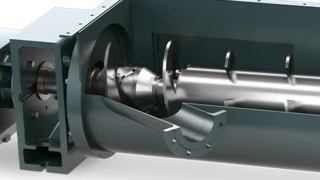
To meet these requirements, one of the world’s leading companies in the field of paper recycling relies on NETZSCH progressing cavity pumps at its paper mill in Schongau, Bavaria, among other places. The conveying technology was specifically designed to meet the requirements of waste paper processing, enabling reliable conveyance of sensitive pulp while maintaining process stability. NEMO® BF hopper shaped pumps with feeding screw are used, which are specially designed for viscous, solid-laden and sensitive media. As with all progressive cavity pumps, the operating principle is based on an oscillating Rotorrotor,Rotors,rotorsrotor moving within a geometrically adapted fixed stator. This creates continuously closed pumping chambers that evenly transport the medium from the suction to the pressure side. The pumping principle minimises internal turbulence and prevents uncontrolled dewatering during transport. At the same time, the low-pulsation operation across the entire speed range ensures a uniform volumetric flow and enables precise, reproducible dosing of waste paper. Even with double-digit solids content and changing media compositions, the conveying process remains stable and controllable.
At the paper mill in Schongau, a NEMO® BF pump feeds a three-metre-wide conveyor belt within a dewatering plant. A second unit, designed as a hopper pump, is removing excess waste paper. Around 50 cubic metres of the 55 °C medium with a solids content of eleven to twelve percent is conveyed at a pressure of 3.5 bar into a truck, transporting the pulp to another production facility with free capacity. The result is significantly increased process stability with consistent raw material quality. Gentle conveying helps maintain the homogeneity of the raw mass and enables the utilisation of even periods of overproduction in an economical and resource-efficient manner.
Contact the experts at NETZSCH to design your recycling application with process reliability. We will be happy to assist you in selecting the right pump technology.
NEMO® BF hopper shaped pump with feeding screw
- Medium: Waste paper
- Capacity: 50 m³/h
- Pressure: 3,5 bar
- Temperature: 55 °C
- Other: Solid content of 11 to 12 %