STARCH SOLUTION
Pumping Hot Starch Solution in Paper Production
Stabilise surface glueing with low-pulsation pumping
How can a hot, corrosive starch solution be conveyed reliably without damaging the sensitive structure of the medium? And how can a constant dosage be maintained while ensuring consistent paper quality? In the paper and corrugated cardboard industries, the transport of starch solutions places the highest demands on pump technology, materials, and process stability.
As a global specialist for positive displacement pumps, NETZSCH Pumps & Systems offers technically adapted solutions for demanding media such as hot starch solution. We will show you how to improve delivery stability, dosing accuracy, and plant availability with the right pump.

Individual Consulting

Starch solution as a key medium in paper glueing
After the food industry, starch is the most essential raw material in the production of paper and corrugated board. In surface glueing, a starch solution makes the paper hydrophobic, allowing it to be printed or written on evenly. To achieve this, the medium must be conveyed to the coating system in a precisely defined thermal and rheological state. In this process, the starch solution must be conveyed at around 80 °C, as this is the only temperature at which the starch swells completely and develops a paste-like consistency. At the same time, the medium has a viscosity of around 160 mPas and is sensitive to pulsations and shear forces. This is further compounded by its chemical aggressiveness, which attacks unprotected metal components and causes corrosion.
Challenges in pumping starch solution
In a large paper factory in Hesse, more than 150 cubic metres of starch paste had to be continuously conveyed to the coating line every hour. For years, centrifugal pumps were used for this purpose. However, this technology proved to be unsuitable for the sensitive medium. The pulsation caused by the design placed mechanical stress on the starch mixture, negatively affecting the glue’s quality. In addition, cavitation occurred in the centrifugal pumps, reducing efficiency and making precise dosing impossible. The aggressive starch solution also attacked seals and housings, resulting in increased maintenance costs and shorter service life.
Stable pumping with adapted pump technology
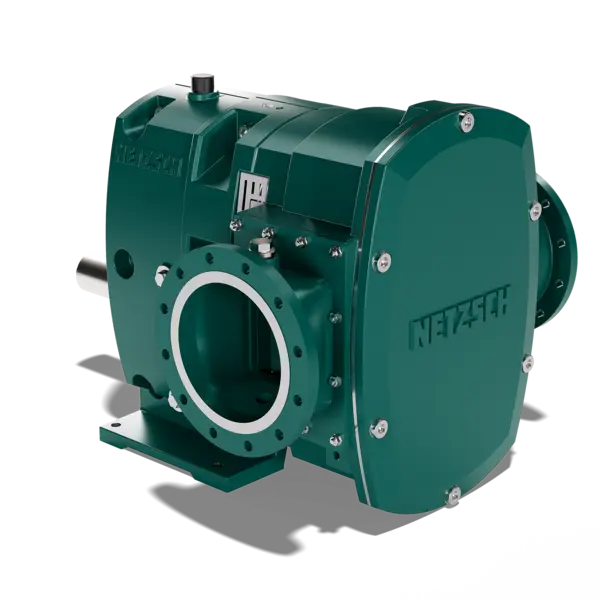
To stabilise the process, the company switched to TORNADO® T1-F rotary lobe pumps to feed the coating system. The self-priming positive displacement pumps convey the hot starch solution continuously and almost independently of pressure fluctuations, thereby providing the basis for stable, reproducible glue application. Several targeted design and material adjustments, tailored to the medium’s properties, were crucial to the conversion's success. Conveyance is proportional to speed, meaning the volume flow depends directly on the Rotorrotor,Rotors,rotorsrotor speed. This allows the required amount of starch solution to be dosed precisely and reproducibly, enabling uniform feeding of the coating line. The lobe rotors used, with a three-bladed spiral geometry, significantly reduced pulsations and minimised shear load. This ensured the sensitive starch mixture was transported with particular care and that its functional properties were retained. Ethylene-propylene-diene rubber (EPDM) was chosen for the lobes because this material has high thermal and chemical resistance. This reliably prevents premature material degradation, even with a starch solution at around 80 °C. In addition, the pump housing is lined with stainless steel to provide long-lasting protection against corrosion from the aggressive medium and to significantly extend the pump’s service life. Another safety-related aspect is the physical separation of the pump and gearbox compartments, which prevents the medium from entering the drive. This increases operational safety even under permanently demanding operating conditions.
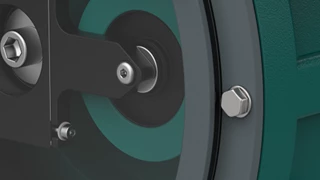
In addition, encapsulated mechanical seals were used, which are less susceptible to clogging by the sticky starch solution and allow for longer maintenance intervals. The large housing cover also facilitates access to the pump chamber, enabling cleaning or service work without dismantling the housing or the connected pipes. In total, the paper mill installed three TORNADO® rotary lobe pumps, one of which is designated as a backup for maintenance or cleaning. Using rotary lobe pumps has stabilised starch solution delivery. Pulsations no longer occur, cavitation is avoided, and the speed-dependent delivery enables much more precise dosing than before. Compared with the previously used centrifugal pump technology, the operator benefits from significantly higher process stability on the coating line, improved, consistent paper quality, reduced maintenance, and extended service life. In addition, higher efficiency is achieved, even though the new pumps require less space than the previously installed units.
Get in touch with the experts at NETZSCH Pumps & Systems to discuss your application. We will be happy to assist you in selecting and adapting the right pump technology for your paper production.
TORNADO® T1-F rotary lobe lump
- Medium: Starch solution
- Capacity: 80 m³/h
- Pressure: 1,8 bar
- Speed: 375 U/min
- Temperature: 80 °C
- Viscosity: 160 mPas
- Other: Highly corrosive, shear-sensitive