SLAUGHTERHOUSE WASTE
Turning Slaughterhouse Waste to Fermentable Biogas Substrate
How a shredding and conveying system prepares poultry residues for biogas production
Fresh, locally sourced chicken, produced entirely in-house: International Fresh Food has built a closed-loop production cycle in North Macedonia that covers breeding, feed production and a modern abattoir. A truly closed loop, however, also requires effective management of the residues generated during slaughter. This is where one of the concept’s greatest technical challenges lies.
As a global specialist in handling complex media, NETZSCH Pumps & Systems offers solutions making even difficult-to-handle residues reliably manageable. We show you how a coordinated shredding and pumping concept turns slaughterhouse waste into a valuable energy source for a company’s own biogas plant.

Individual Consulting
Challenges when pumping slaughterhouse waste
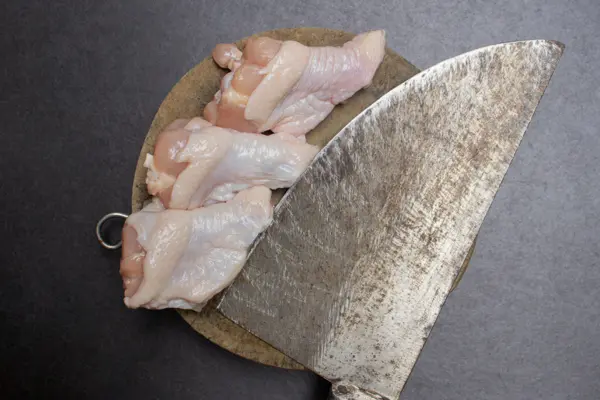
Ninety-five percent of the waste consists of chicken heads and legs. It is a heterogeneous, solids-rich mixture containing bones, cartilage, feathers and beaks, along with fat and cartilage components. The solids content is around 15 percent, and the medium is highly viscous and, in some cases, stiff. “It can clog pipes, block pumps and damage the elastomers inside the equipment”, explains Michael Zabelt, International Area Sales Manager at NETZSCH.
Why untreated residues limit gas yield
Beyond conveying, utilisation also places high demands on the material. Untreated, it would not allow a high gas yield in the biogas plant. Residues must be as fine and homogeneous as possible: the larger the surface area of individual particles, the more efficiently they ferment in the digester. A pump alone cannot meet this requirement. Shredding and conveying must be planned together from the outset.
The solution: Three steps on a common frame
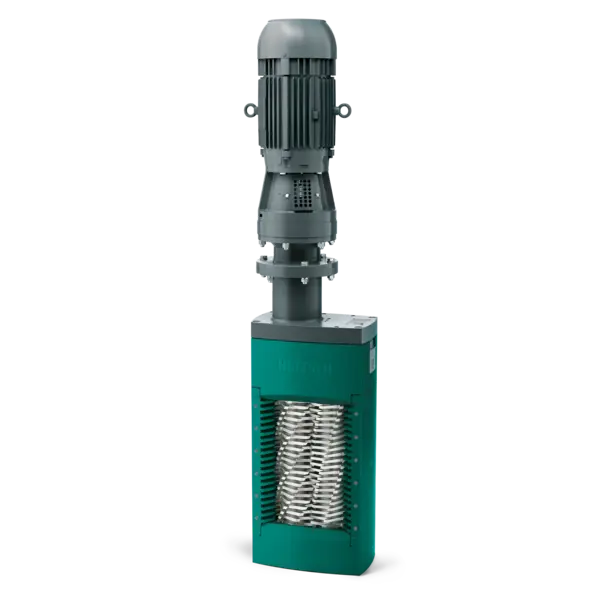
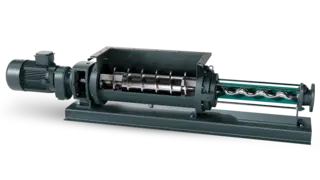
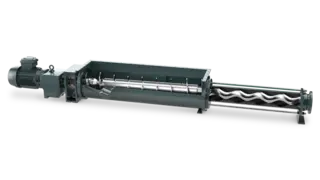
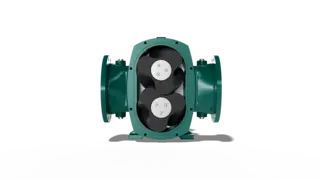
International Fresh Food therefore relies on a two-stage shredding and conveying system from NETZSCH. The core of the plant is a combination of an N.Mac® channel twin shaft grinder, a NEMO® BF hopper shaped pump with feeding screw and a downstream M-Ovas® universal cutting plate macerator, all mounted on a common frame. In the first step, the N.Mac® pre-shreds the raw material at a throughput of 250 m³/h. Two counter-rotating shafts fitted with knife blocks cut and break up the coarse solids. The modular cutter blocks, which allow cutting units with three to eleven teeth, made it possible to tailor the blade configuration to the application. Bones, beaks and chicken feet are thus reliably broken down. “The aim of coarse shredding is to produce a medium that is essentially pumpable and poses no problem for the downstream pump”, explains Zabelt. The N.Mac® thereby protects the downstream pump against blockages and mechanical damage. The coarsely shredded material then falls directly into the feed hopper of the NEMO® BF. This progressing cavity pump is designed for highly viscous, solids-laden and, in some cases, stiff media and conveys the slaughterhouse waste at a continuous pressure of three bar. Its rotor-stator system moves enclosed conveying chambers continuously from the suction side to the discharge side. Because the chambers overlap, even this demanding medium is conveyed in an almost uniform, low-pulsation flow with no pressure peaks and therefore no risk of blockage. This provides a stable basis for plant operation.
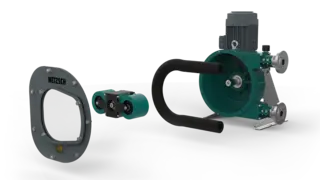
In the third step, the M-Ovas® reduces the particles to twelve millimetres. The material fed by the NEMO® is pressed against a wear-resistant cutting plate and cut by a rotating cutter head until it passes through. For demanding process conditions, the M-Ovas® is built in a reinforced version, withstanding pressures of up to two bar. The result is a homogeneous, readily fermentable substrate that significantly improves the efficiency of biogas production. The plant was successfully commissioned at the end of 2025. Close coordination between International Fresh Food, its local partner Vatalko and the pump specialists at NETZSCH allowed the system to be designed optimally for the characteristics of the medium, from bones and feathers to fat and cartilage. “Slaughterhouse waste is no longer seen as a disposal problem but as an integral part of a closed production and energy cycle”, says Zabelt.
The project shows how important it is to consider shredding and conveying technology from the outset when designing a production and energy concept. Contact the NETZSCH experts if you also want to convey solids-laden residues reliably and prepare them for biogas production.
N.Mac® channel twin shaft grinder, NEMO® BF hopper pump with feeding screw and M-Ovas® universal cutting plate macerator