APPLES
Cutting and Conveying Apples in Just One Process Step
This pump solution increases the efficiency of your apple juice production
In the food industry, conveying systems must, first and foremost, be hygienic, easy to clean, and suitable for food. Once these requirements have been met, another factor comes into focus: The efficiency of the entire process chain. Particularly when processing fruit into juice concentrate, large quantities of raw material have to be reliably chopped and continuously transported onward.
As a global specialist in handling complex media, NETZSCH Pumps & Systems offers solutions allowing you to combine conveying and grinding in a single process step. We will show you how to increase efficiency in the production of apple juice concentrate.

Individual Consulting
Requirements for pumping fruit mash
When processing fruit into juice concentrate, conveying systems must handle widely varying product properties. Whole apples or large pieces of fruit have limited flowability and must be chopped up before further processing. This step produces a heterogeneous medium consisting of pieces of fruit, fibres and liquid. The combination of solid and liquid components places high demands on the pump technology used. Large particle sizes and high solids content make uniform conveying difficult, while varying viscosities complicate it. In addition, the product is sensitive to high shear forces, as excessive mechanical stress can alter the product structure. In addition to the rheological properties of the medium, chemical and hygienic aspects also play an important role. Fruit acids are corrosive and require resistant materials. At the same time, the food industry has strict requirements regarding hygiene, cleanliness, and the suitability of components that come into contact with the product. To ensure the reliable operation of downstream process steps, such as centrifuges, conveying must remain stable and continuous despite challenging conditions. A uniform product feed forms the basis for efficient and reliable further processing.
Reducing process complexity in fruit processing
A food company in the Brazilian state of Rio Grande do Sul set up a new production line for manufacturing apple juice concentrate. At the plant, the delivered apples are cleaned and processed without further pre-treatment, then processed into fruit mash. In many plants, whole fruits are conventionally crushed using separate cutting or crushing units. Only after this process step is the resulting fruit mash transported via pump systems to downstream process stages such as centrifuges. However, separate shredding machines increase the investment costs of the production line, and, on the other hand, create additional interfaces between the individual units, which represent potential points of failure during operation. Maintenance and service costs also increase because several machines must be regularly inspected and serviced. In addition, such a plant configuration requires more space in the production line. Against this background, the company sought a solution that efficiently combines shredding and conveying in an integrated system.
Integrated pump solution simplifies process
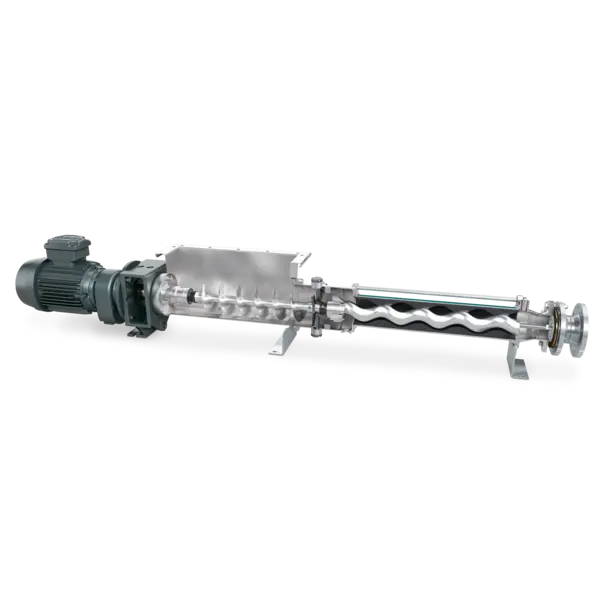
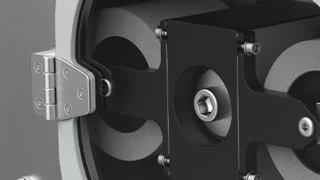
For this application, the company opted for a NEMO® BO/SO hopper pump with cutting device. The pump operates according to the eccentric screw principle. A rotating Rotorrotor,Rotors,rotorsrotor moves within an elastic stator, forming closed delivery chambers that continuously transport the medium from the suction side to the pressure side. As the chambers’ volume remains constant, the delivery is low-pulsation and pressure-stable. A key feature of the solution used is the integrated cutting device. It allows you to combine whole-fruit shredding with subsequent delivery in a single process step. The cutting unit consists of a rotating knife with three blades and stationary counter knives. Whole apples are chopped immediately upon entering the pump and then transferred to the lobe rotors. The hopper housing with integrated screw conveyor ensures reliable feeding. This enables uniform conveying even with a high solids content.
Optionally, the pump can be equipped with an additional cutting device on the pressure flange. This consists of a shear plate and a rotating knife that define the particle size of the solids upon exit from the pump. The choice of materials is also tailored to the food industry’s requirements. The hopper housing, rotor and other rotating components are made of CrNiMo 17-12-2 (V4A stainless steel), which is highly resistant to fruit acids. The stator is made of an elastomer resistant to fruit acids as well as alkaline and acidic cleaning agents. All materials that come into contact with the product comply with FDA requirements and Regulation (EC) 1935/2004. After shredding, the pump continuously conveys the resulting apple mash to the centrifuge, where the juice is further processed. The system was delivered in February 2020 and has been operating stably and reliably since its installation at the factory in Rio Grande do Sul. By using the NEMO® BO/SO, the food company was able to combine several process steps. The shredding of whole apples and the subsequent conveying of the apple mash now take place within a single unit. This significantly reduces the system’s complexity.
This results in several advantages for operators. The elimination of separate cutting units reduces the investment costs of the production line. At the same time, there are fewer interfaces in the process, which minimises potential sources of interference. Continuous, low-pulsation conveying also enables stable feeding to the downstream centrifuge. Despite high solids content, conveying is gentle on the product and reliable. Contact the experts at NETZSCH to efficiently combine conveying and grinding in your food production. We will be happy to assist you in designing a pump solution tailored to your application.
NEMO® BO/SO hopper pump with cutting device
- Medium: Whole apples and apple mash
- Speed: Variable, proportional to the flow rate
- Other: Chunky fruit pulp with a high solids content