FLUE GAS DESULPHURISATION SLUDGE
A Reliable Way to Convey Abrasive FGD Sludge
How a coal-fired power plant in Germany benefits from NETZSCH pumps
Flue gas desulphurisation is a key component of modern power plant processes, as it significantly reduces sulphur dioxide emissions and thus reliably complies with statutory emission limits. However, the flue gas desulphurisation sludge (FGD sludge) produced in the process is one of the most challenging media to convey in thermal power plants. High chloride content, up to 14 percent solids and a strong tendency to sedimentation lead to increased wear.
To avoid unplanned downtime, a large coal-fired power plant in North Rhine-Westphalia, Germany, relies on a NETZSCH rotary lobe pump, specifically optimised for conveying FGD sludge. Discover how to benefit from this innovative pump solution.

Individual Consulting
Challenges when pumping FGD sludge
The handling of exhaust gases, which are potentially harmful to the environment or health, is strictly regulated in Germany, among other things, by the TA-Luft (Technical Instructions on Air Quality Control) and the Federal Immission Control Act. For example, flue gas desulphurisation has been mandatory for hard coal-fired power stations since 1974. Pollutants such as particulate matter, heavy metals and sulphur compounds are usually captured and removed using scrubbing suspensions, meaning in an ideal case the exhaust air contains little more than water vapour, carbon dioxide and, in some cases, carbon monoxide. However, this process produces FGD sludge as a waste product, which, in the case of the aforementioned power plant, is around 40 to 50 °C hot and, at 15,000 to 20,000 ppm, has a chloride content similar to that of seawater, making it a challenging pumping medium. In combination with fine dust, heavy metals and sulphur compounds, this creates a highly corrosive mixture. In addition, the dry matter content is up to 14 percent. The particles contained reach up to 1.5 millimetres in size and settle quickly due to their density. In practice, this tendency to sediment leads to increased wear on components in contact with the medium, permanent corrosion of metal components and a risk of deposits and blockages in the pump chamber. At the same time, the sludge's inhomogeneous composition makes stable, uniform pumping difficult.
Customised solutions for most demanding requirements
When searching for a pump not only chemically resistant but also designed to avoid dead spaces, minimise sediment, and reduce wear-intensive contact zones, the operator of the hard coal-fired power plant in North Rhine-Westphalia turned to NETZSCH Pumps & Systems. The aim was to develop a robust, corrosion-resistant, and low-maintenance pump solution that ensures stable process control even under demanding conditions. The global specialist in handling complex media opted for a rotary lobe pump. This is based on the proven positive-displacement principle but has been redesigned in terms of drive, geometry, and material selection to ensure largely maintenance-free operation and a high level of operational reliability. A key element was the special design of the pump chamber, pistons, and seals.
How to convey REA sludge with low wear
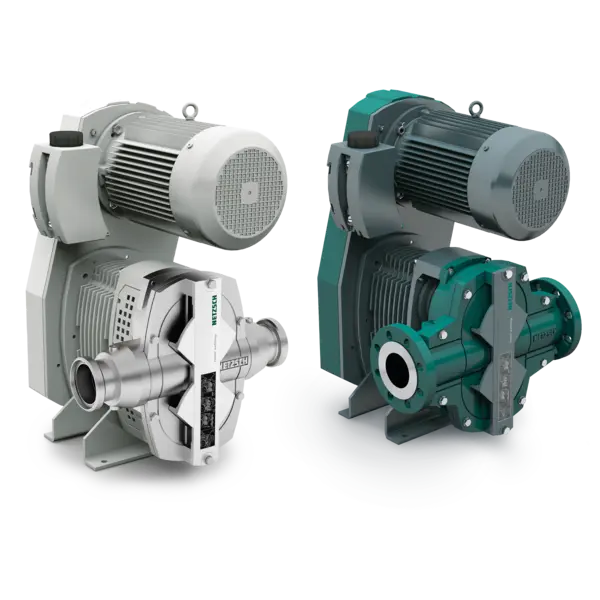
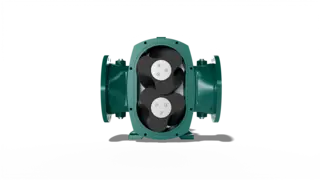
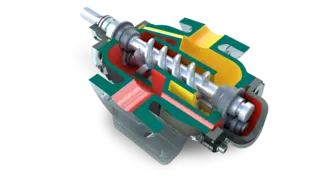
The selected TORNADO® T.Proc® rotary lobe pump features rotary lobes mounted outside the pump chamber using quick-release fasteners, eliminating the need for screw unions within the delivery area. The front sides of the pistons remain smooth, offering no points of attachment for the medium to adhere to. This concept is supported by the straight, two-bladed form of the lobe rotors, which, unlike complex helical variants, have no valleys in which solids could accumulate. Despite this simple design, pulsation is kept to a minimum thanks to a special housing geometry. Dead spaces have also been avoided in the shaft sealing systems by positioning the sliding surfaces flush with the rear of the pistons. The pre-set seals in the cartridge design are simply pushed onto the shaft with the lobe rotor during assembly. To reliably prevent abrasive particle deposits, double-acting mechanical seals flushed with water during operation have been installed. Another special feature is the reversal of the usual material combination. Instead of the usual elastomer pistons, two hardened steel pistons are used here, rotating in a pump housing lined with a geometrically adapted elastomer insert.
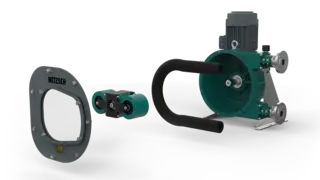
In addition to the pump's robustness, ease of maintenance was an essential aspect for the power plant operator. The T.Proc® pump can be maintained and repaired without complicated disassembly. The entire front can be removed like a top cover, making the pump housing freely accessible up to the flange connection and providing space for inspection, cleaning, or replacement of parts. This means the rotors can be installed and removed in just a few simple steps, especially since the simple blade geometry also allows a single piston to be replaced independently of the other. Thanks to the adjustment and setting device integrated into the front cover, no additional axial adjustments are necessary after replacement. The robust drive, the resistant materials, and the maintenance-friendly, dead-space-free design of the T.Proc® ensured the pump has been operating without any problems in the North Rhine-Westphalian coal-fired power plant since commissioning. The pump transports between eight and 15 cubic metres of corrosive FGD sludge, ensuring that flue gas scrubbing can always be carried out as required by law.
Contact our experts to optimise your exhaust gas cleaning application. We will help you select the right solution for your challenges.
TORNADO® T.Proc® rotary lobe pump
- Medium: Flue gas desulphurisation sludge (FGD sludge)
- Capacity: 8 to 15 m³/h
- Pressure: 2.5 bar
- Temperature: 40 to 50 °C
- Other: Up to 14 % solid content, particle size up to 1.5 mm, highly abrasive and corrosive