Beer
Gentle and Automated Beer Conveyance Increases Efficiency
How to optimise mash, spent grain and yeast transport in your brewery
Malting, mashing, lautering, boiling and fermenting: each of these process stages places its own demands on conveying technology. How can sensitive media, such as mash or liquid yeast, be transported reliably without altering their structure? And how can you reduce manual tasks while increasing plant availability? In modern breweries, the right pump technology is crucial for product quality, process reliability and cost-effectiveness.
As a global specialist in handling complex media, NETZSCH Pumps & Systems offers innovative solutions for all process steps in the brewery, from raw material feeding to waste disposal. We show you how our pump technology can reliably handle even the most demanding media.

Individual Consulting

Challenges for pumps in breweries
Breweries handle a wide variety of media differing significantly in terms of viscosity, solids content, temperature and sensitivity. Mash contains solid components, such as husks, and, depending on the process stage, can reach temperatures up to 100 °C. It is shear-sensitive, as mechanical overloading can impair its filtration capacity during lautering. Beer draff, on the other hand, is a non-flowable, highly abrasive solid with varying moisture content, produced after lautering. The discharge temperature is typically around 65 °C. The mass tends to form bridges, placing high demands on the pump’s feed and wear resistance. Liquid yeast, in turn, is highly sensitive to shear forces and pressure surges. At the same time, the highest hygiene requirements apply in this section to prevent contamination. In addition, long conveying distances, confined spaces, and the requirement for CIP (cleaning-in-place) or SIP (sterilisation-in-place) capability are common in many breweries. A universally applicable, media-compatible pump solution is therefore essential.
When standard technology reaches its limits
Centrifugal pumps are used in numerous existing plants for many applications. This technology is optimally designed for low-viscosity, homogeneous media. Centrifugal pumps are particularly efficient and significantly more cost-effective compared to positive displacement pumps. However, this technology quickly reaches its limits when dealing with viscous or solids-laden substrates. Fluctuating viscosity in particular leads to unstable pumping conditions, as the flow rate and pressure are highly dependent on the operating point. Reproducible process control is only possible to a limited extent under these conditions. In addition, there are relatively high shear forces and pulsations, which can adversely affect sensitive media. In mash, this can impair husk structure and make filtration during the lautering process more difficult. With liquid yeast, there is a risk of damaging cell structures, thereby impairing product quality. Further weaknesses become apparent during the discharge of spent grain. The non-flowable, sometimes very dry and abrasive solid material often leads to blockages in the inlet area. Insufficiently filled pump chambers promote dry running, which leads to increased wear and unplanned downtime. Service life is significantly reduced, while maintenance costs increase. There are also disadvantages in terms of process technology. In the partial mashing process, the mash must be removed from the vat, heated separately and returned. With single-sided pumps, this process can only be done with extra conductors, fittings and gate valves. As the pipe network becomes more complex, the number of potential leakage and contamination points increases, and the cleaning effort accordingly. In older plants, discharge is still done manually in some cases. This approach is labour-intensive, ergonomically unfavourable and prevents continuous process control. At the same time, the risk of production interruptions increases if the discharge is not synchronised with the lautering process.
Holistic pump solutions for breweries
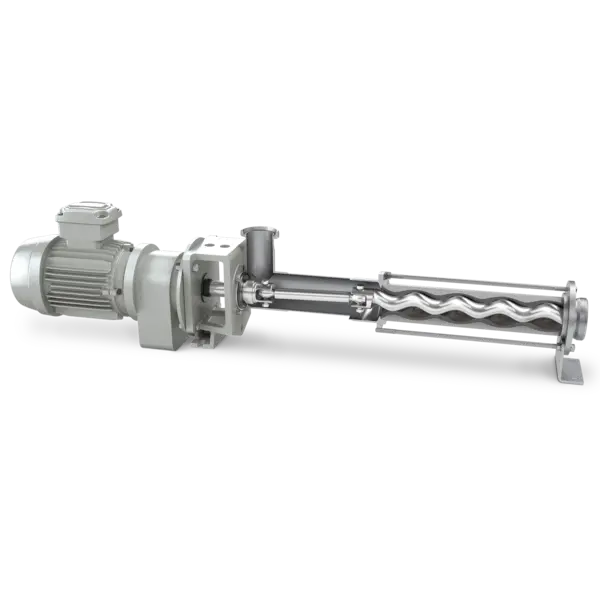
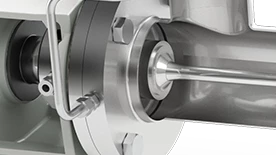
NETZSCH offers pump solutions optimally designed to meet the requirements of almost all complex conveying tasks in breweries. Depending on the process step, pumps of different designs are available. The NEMO® BF hopper shaped pump with feeding screw is particularly effective when conveying mash. The rotating system, consisting of a Rotorrotor,Rotors,rotorsrotor and a stator, enables particularly gentle, low-pulsation conveying without shear forces. This preserves the structure of sensitive components such as husks and solid particles. The constant delivery volume, regardless of viscosity and consistency, ensures high process reliability and precise volume control through speed. This technology ensures consistently reliable performance, especially in the brewhouse's changing temperature range. NEMO® progressing cavity pumps, such as the BH in compact block design, are also used to pump original wort. The low-pulsation and low-shear delivery protects the quality of your wort and prevents unwanted oxygenation. Thanks to the constant delivery characteristics, the pressure remains stable, ensuring uniform further processing in the subsequent step. The speed-controlled operation also allows exact adaptation to different brew sizes and process conditions. For discharging the spent grains from the lauter tun, specially designed progressing cavity pumps such as the NEMO® BF hopper shaped pump with aBP-Module® are suitable. The non-flowable, abrasive malt cake, which can reach temperatures of up to around 65 °C, places high demands on the conveying technology. An integrated feeding screw ensures that sufficient medium is always fed into the conveying chambers. As a result, the spent grains are continuously transported from the open inlet hopper to a silo or dump truck, for example. Robust materials, such as stainless steel, combined with suitable elastomers, guarantee a long service life, even under highly variable conditions and high wear potential. NEMO® progressing cavity pumps also make an important contribution to process stability when feeding filters and separators. Low-pulsation conveying prevents mechanical overloading of sensitive filter elements, thereby supporting efficient and uniform filtration. The constant conveying characteristics keep pressure stable, increasing filter service life and boosting productivity throughout the rest of the brewing process.
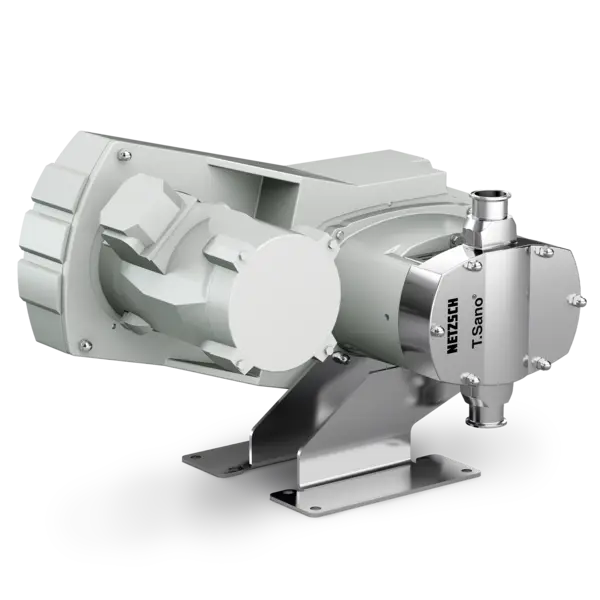
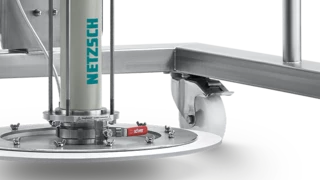
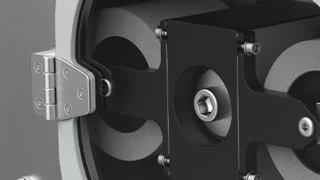
For highly sensitive media such as liquid yeast, NETZSCH offers special hygienic pumps, such as the TORNADO® T.Sano® rotary lobe pump with smooth surfaces. Polished surfaces, dead-space-free construction, and hygienic shaft sealing ensure maximum product safety and ease of cleaning. The pumps are optionally designed for CIP or SIP processes. Thanks to speed-controlled delivery, the yeast can be dosed directly with high measuring accuracy, eliminating the need for additional dosing systems in many cases. The gentle delivery protects sensitive yeast cells and ensures the quality of the end product. Rotary lobe pumps with hygienic design are also used in the brewhouse, especially in traditional partial-mashing processes. These pumps can reverse flow direction, significantly simplifying the pipe network. At the same time, they operate quietly and gently so that the mash husks are not damaged. This allows 75,000 to 140,000 litres of brewing mash at up to 100 °C to be reliably pumped per hour. The compact design, large free-ball passage, and easy maintenance further increase operational reliability in the brewhouse. In addition to stationary installations, NEMO® progressing cavity pumps and TORNADO® rotary lobe pumps are also used as mobile units. Smaller and medium-sized breweries in particular benefit from this flexibility, as the pumps can be used at different stations.
Whether in the brewhouse, fermentation and storage cellar, or in ancillary processes, these robust, low-maintenance pump solutions help reduce personnel costs, automate processes, and achieve modern, economical beer production across all areas. Let our experts advise you and find the pump solution optimally tailored to your brewery application.
TORNADO® T.Sano® rotary lobe pump, NEMO® BF hopper shaped pump with feeding screw, NEMO® BH hygienic pump in compact block design
- Medium: Mash, spent grains, liquid yeast, original wort
- Flow rate: 75,000 to 140,000 l/h
- Temperature: Up to 100 °C
- Other: Varying consistency, highly abrasive spent grains, shear-sensitive yeast