FISH WASTE
Closed System Optimises Production of Fish Peptide Isolate
How to pump fish waste hygienically and stably over hundreds of metres
An Ecuadorian company processes fish waste into high-quality fish peptide isolate for the animal feed industry and faced the challenge of transporting the viscous, inhomogeneous fish residues within the plant over several hundred metres. To meet hygienic requirements while maintaining cost-effectiveness, the company turned to NETZSCH Pumps & Systems.
Together with the Ecuadorian company, experts from the global specialist in handling complex media developed a closed system requiring significantly less manpower while also meeting hygiene requirements. Discover how we combine process reliability and cost-effectiveness with our sophisticated technical solutions.

Individual Consulting

Challenges when pumping fish waste
Fish waste places high demands on the conveying technology used. The medium is inhomogeneous in composition and consists of fish heads, bones, skin and meat in varying sizes. At the same time, it has a high moisture content and a viscous consistency. To ensure a stable conveying process, large amounts of solid matter must be reliably picked up without causing blockages, increased wear, or excessive shear forces. In addition, long conveying distances of several hundred metres and stringent requirements for cleanliness and occupational safety are imposed, as open conveying systems entail odour pollution and hygiene risks.
High logistics costs and hygiene issues
In the existing plant, fish waste was transported internally using long screw conveyors, forklift trucks and open boxes. This concept involved a high level of logistical effort and required considerable manpower. In addition, it was an open system which did not meet hygiene requirements or expectations for a clean production process. Contamination, time-consuming cleaning work and limited process stability led to increased operating and maintenance costs. A closed, continuous conveyor solution was therefore required.
NETZSCH ensures stable, hygienic conveyance
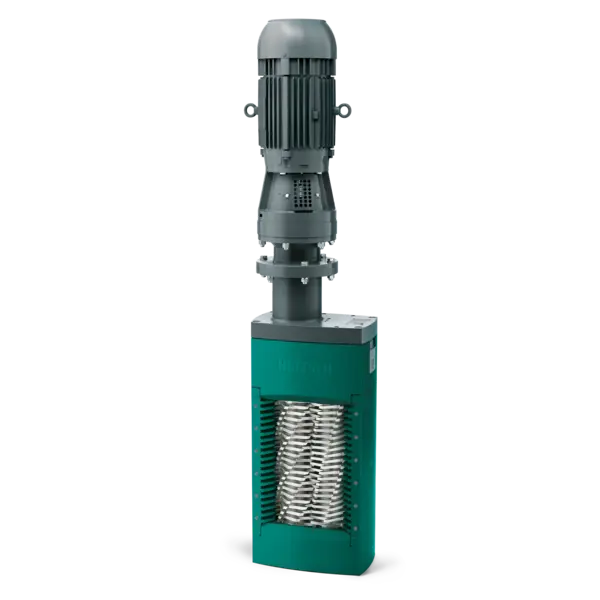
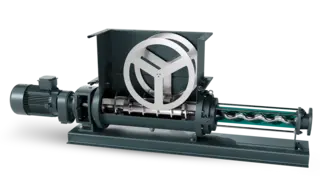
NETZSCH worked with the Ecuadorian company to implement a conveying solution comprising two NEMO® BF progressing cavity pumps, complemented upstream by N.Mac® channel twin shaft grinders. The pump technology is based on the proven rotor-stator conveying principle, in which closed conveying chambers continuously move from the inlet to the outlet. This ensures the medium is conveyed at a stable volume and pressure, regardless of its viscosity or consistency. The large-volume inlet hopper of the NEMO® BF hopper pump, in combination with the integrated transport screw, ensures uniform product feeding even with irregular material. This ensures stable conveying without bridging. The underlying progressing cavity pump technology also enables conveying with minimal pulsation and low shear forces, which is particularly advantageous when handling sensitive fish waste. To reliably process large components, such as fish heads or bones, N.Mac® twin shaft grinders were installed upstream of the system. These perform the pre-shredding of the medium so the solids can be easily absorbed into the pump’s conveying chambers. Consequently, the risk of blockages and increased wear is significantly reduced. The system is supplemented by a fully closed piping system, eliminating the need for open handling of the medium and thereby improving both hygiene and occupational safety. The robust design of all units also reduces maintenance requirements and extends service life under continuous operation. One of the installed pumps conveys up to five tonnes of fish waste per hour through a 230-metre-long pipe with a diameter of 100 millimetres. To assist transport, air pulses with a pressure of six bar are introduced into the pipeline immediately behind the pump. The second pump transports 15 tonnes of fish solids with a moisture content of around 40 percent per day through a 30-metre-long feed line into the same conveyor line, which empties into a sedimentation tank.
This combination of a grinder and a pump enabled a fully closed conveying process. Manual transport by forklift truck and the use of open boxes, previously necessary, are now eliminated. The system has been operating without issues since it was commissioned more than two years ago. The operator benefits from significantly improved process stability, reduced operating and maintenance costs, and better hygienic conditions in the production environment. At the same time, the number of personnel required for internal transport has been reduced.
Contact the experts at NETZSCH Pumps & Systems to analyse your application together. We will be happy to support you in designing an economical and process-reliable conveying solution for demanding media.
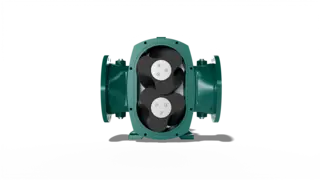
NEMO® BF hopper shaped pump with feeding screw and N.Mac® channel twin shaft grinder